Written and illustrated in plain, approachable English for learners at approximately high-school level, with AI-supported content informed by in-depth 2025 conversations with pioneering AI scientist and 2024 Nobel Prize in Physics co-laureate Geoffrey Hinton).
Listen to Aiko & Blaise AI podcast: aiPod 052 – Guide to Mentoring the Mentor in You with ai:Pods (Long play, 35:37 min)
Aiko & Blaise, my fictitious AI podcast avatar hosts dive deeper for you… They keep changing appearance purposely – so just don’t expect to know how they look like!
They are not programmed to mimic fixed-size character faces or behaviors (like avatars often are). Instead they are created as fluid actors across multiple AI-based visual possibilities and are meant to adapt in different skins over time.
Aiko & Blaise are for example the fictitious hosts voiced in the ai:Pod 052Audio podcast (above). These are current, typical NotebookLM Audio overview voices.
You can also Interact with the hosts with Voice chat and let them guide you on the spot! (Voice chat is currently English spoken Only, but allows multilingual textual entry prompting)MindMap available from ai:Pod 052 – Guide to Mentoring the Mentor in You, visit this free dedicated NotebookLMHow to Start – Quick Guide
Quick Guide for kinokast’s ai:Pods
This Quick guide is designed to help you interact with the kinokast ai:Pods and your own sources within NotebookLM to move from “information” to “strategic oversight” and more learning how to learn.
1. The Kinokast Self-Mentoring Workflow
Before asking the AI for an answer, follow this three-step reflection:
Hypothesize: Write a one-sentence “Note” in NotebookLM about what you think the answer is based on your current expertise.
Challenge: Ask NotebookLM: “Based on the kinokast ai:Pod sources, what is the ‘Alien’ perspective that contradicts my hypothesis?”
Synthesize: Use the “Save to Note” feature to combine the AI’s pattern-recognition with your human judgment.
2. Optimized Prompts for ai:Pods
Use these prompts in this NotebookLM chat to extract deeper insights:
For Strategic Oversight (The Pivot)
“Identify the ’embodied cognition gaps’ in my current project documentation. Where is the AI likely to be ‘super-deluded’ because it lacks physical presence or human intuition?”
For Security & Vigilance (The 250-Document Rule)
“Analyze my sources for internal contradictions. If 5% of this data were ‘poisoned’ or biased, which specific conclusions in my project would be the most vulnerable?”
For Ethical Alignment (The Political Economy)
“How does the implementation of the strategies discussed in these sources impact human dignity? Does this workflow automate ’emancipatory’ tasks or ‘repetitive drudgery’?”
3. How to Use the “Audio Overview” as a Mentor
Generate the Deep Dive: Listen to the two AI hosts discuss your sources.
The Oversight Task: Listen specifically for what the AI misses or oversimplifies.
The Questioning: Use the “Interactive Mode” (if available) to interrupt and ask: “You just mentioned X, but how does that reflect the ‘automation paradox’ mentioned in the kinokast guide?”
4. Key Concepts to Track
Strategic Oversight: The human role of judging usability and intent.
Alien Intelligence: Non-human logic patterns.
Super-Delusion: High-velocity intelligence without wisdom.
Exploring AI • UX Design • Tech • Culture • Science • Philosophy • Life
The conversation around artificial intelligence (AI), artificial general intelligence (AGI) and artificial super intelligence (ASI) often feels like a pendulum swinging between two extremes: a utopian future of cured diseases and radical abundance, and a dystopian nightmare of joblessness and rogue machines. (December 2025)
These five realities reveal the stark duality of artificial intelligence. It is a technology that holds the power to restore the human body and cure disease, yet in the same breath, it enables new forms of global labor exploitation and psychological predation, not to mention the upcoming new autonomous weapons of mass destruction. Read more: “The Alien Intelligence”
It is developing an alien intelligence we don’t fully understand while forcing us to confront the deepest questions of human morality.
The greatest challenge is not to create more powerful technology. It is to develop the wisdom to use that power for good.
As AI becomes ever more powerful, the most important question is not what it can do, but what we will have the wisdom to do with it. Starting in 2026!
AI or genAI (generative AI), just as humans, may provide incorrect, bias or misleading responses. Human language is vulnerable and sourced directly into AILarge Language Models (LLM).What’s going on?
Kinokast ai;Pods Help You Unleash Your Inner Mentor – Question Everything!
Ask and chat with my new Gemini 3 app anything from my ai:Pods
Mentoring the Mentor in You…
Learning to learn at your own pace:
Curated AI voiced Audio Podcasts that cut through the crap (spoken mostly in English)
Live, Interactive Voice Chats with AI – Ask anything, get answers in real-time
Human Vetted, Sourced Research – FREE access via dedicated NotebookLM
Your questions. Your critical thinking. Answers you can use directly.
Welcome to my blog at kinokast
I’m Jerome Bertrand – an AI UX designer, design educator, and visual artist/photographer. I create interactive AI podcasts called ai:Pods to explore AI, UX design, science and culture and how they’re shaping our work and lives.
Topics by colour:
My Blue ai:Pods = AI, UX design, Education
My Purple ai:Pods = Science, Culture, Society, Life
Topics from different backgrounds and directions are matched and tend to overlap at times, for my own creative research purposes. In that way they listen to my own subjectivity. I do not pretend to be objective or complete, let stand always exact or correct in treating the many public and seriously curated sources.
Listen to for example, ai:Pod 019, Audio only (‘Reflexive UX design Trajectories, 33 min) => Research sources & Voice-chat with the full NotebookLM
Visit my blog to explore most ai:Pods, current topics (they are typically published there first)
Check my calendar & book a free chat with Zoom or Google Meet.
Mentoring the mentor in you?
Allow yourself a QuickLaugh – before some serious stuff.
This is a humorous teaser talking head video intro from my recent blog ai:Pod 045 , not the aiPod 046 mentioned rather wrongly in the video script. This was produced with the early version of Lemon Slice (November 2025)
Note: You’ll notice the imperfections in this talking head video – the glitches and visual aberrations. It’s intentional to let them intact from human correction here. I want to show AI as it truly is, not sugar-coated with hyper-realistic, advertising-polished visuals that tolerate no deviation from aesthetic norms (whatever they may be). We humans are creative and thrive first and foremost on (our) mistakes – that’s what drives us to get better. This is my way of adding a humanistic touch to the automatic machine-rendering: to keep us humans alert, not lulled to sleep.
I like the mistakes because they tell me something more than meets the eye: the beholder is human (“beauty is in the eye of the beholder”, The 19th-century Irish novelist Margaret Wolfe Hungerford first used the phrase. Her 1878 novel, Molly Bawn, contains the line).
The testing is done with the new Lemon Slice GenAI prompt to image, text to speech, voice to lip sync video, flow (on a lo budget, with many wrong tries, and minimal humor; this is already dated end of 2025).
*UX AI
Focus is on the User: UX, or User Experience, is about how a person interacts with a digital/ online or app product or service.
Humans create new AI Tools: AI tools offer user experience designers a myriad of new ways to enhance how humans will interact with machines, whilst simultaneously presenting the challenge of designing these AI tools themselves to be intuitive and therefore radically human-centred. Designing with AI, designing AI itself. Humans are thus always at centre.
UX AI means AI-augmented UX, where user experience designers are using a growing number of new AI tools and methods to keep helping humans, primarily. A ethical question.
Explore UX design through curated sources, interactive mind maps, and study guides—powered by NotebookLM AI.
Powered by NotebookLM (Google) with carefully curated sources, mind maps, and study guides — plus a healthy dose of self-aware and necessary humor.
Always free. Occasionally wrong — because AI always needs human judgment. And human judgement is, well, not always right.
Start Mentoring The Mentor in You. – Why?
The work is learning how to learn—do it with empathy for everyone, including yourself.
Welcome to my ai:Pods Podcasts & Notebooks!
ai:Pods are designed to help your exploration and learning about a specific set of themes that I specifically and carefully source to offer a rich sample of information – albeit sometimes with paradoxes of controversies but neverconspiracy theories.
I actively try to avoid conspiracy theories, AI-hallucinated statements or otherwise unverified information, focusing instead on helping find truth through evidence rather than belief. This does not imply I do not make use of jest and self-humor when I find the subject and common sense allow it.
I create these curated “NotebookLM” especially around topics of predilection: AI and user experience design (AI UX), education, society, life, exact sciences, philosophy, sociology, history and more…
ai:Pods – smart podcasts on UX AI (AI-Powered UX*) all about user experience design with AI + topics in education, society, life, science, philosophy, sociology and more…
NotebookLM gives you a range of tools for engaging with this insightful material: you can read the original articles, ponder questions and discuss concepts in chat mode, or absorb pre-formatted summaries like Audio Overviews, Research overviews (reports), or FAQs.
Experiment with the different features to find what works best for you.
Understanding The Sources
This NotebookLM is different from the ones you create on your own because it’s built around pre-loaded sources I have been carefully vetted and formatted to generate the highest quality results. They represent my centres of interest I want to share from a educational , e-learning mode point of view. You won’t be able to add your own sources to the ai:Pods. Notebooks will use only these vetted materials (and your current chat history) to answer your questions or generate summaries.
Explore Using Chat
The “Chat” panel is your primary way to engage with the content of the sources. You can ask questions about the uploaded materials, and NotebookLM will respond based on the information contained in those sources, including citations that link directly back to the most relevant passages. For any given question, you can select or deselect specific sources in the left-hand source panel. This allows you to focus NotebookLM’s attention on the most relevant materials for a particular inquiry.
Try asking questions that you directly associate with the themes for each Notebook! Start from there or click on available summaries and interactive Mind Maps already available (in the right “Studio” panel, with the recognisable purple Mind Map branches icon).
Explore Pre-Generated Summaries
The “Studio” panel gives you other modes for engaging with the content in this notebook.
Audio Overviews: Listen to an AI-generated discussion exploring the most engaging ideas and facts from the sources.
Interactive Mode: Audio Overviews include an interactive feature that lets you join the conversation at any time using voice chat—like participating in a live AI podcast. Your questions aren’t recorded, and this hands-free approach makes learning more accessible and engaging, especially for users who prefer listening over reading. These interactive feature I coined “ai:Pod”, has AI-generated host characters I like to give the names Aiko and Blaise (they are fictitious AI-personas that are there to support your learning process), and while some overviews and ai:Pods’s Audio are available in French, Dutch, German or any other language available, English is the primary language for voice interactions. So please speak to ai:Pods in English.
Mind Maps: Visualize the main topics and related ideas from the sources in a branching diagram, helping you see connections and get a quick overview. If you click on any Mind Map node, NotebookLM will automatically create a prompt in Chat to help you understand that topic.
Reports: This notebook also includes a collection of text-based summaries in different genres, like FAQs, Study Guides, or Timelines.
About NotebookLM
NotebookLM is a great tool from Google for managing projects and information.
Important Note: This NotebookLM’s content is for informational and inspirational use only. It’s not a substitute for professional advice from therapists, financial advisors, or other experts. Please consult qualified professionals for personalized guidance.
AI and humans can make mistakes. Please double-check responses and Audio overviews.
A seemingly “honest” kind of response from AI when pushed to its limits:
“I am just an AI, and while I have access to vast amounts of information, I don’t have personal experiences or emotions.
This can sometimes make it difficult for me to understand and replicate the nuances of human communication, like irony, sarcasm, and specific creative styles.
My responses are based on statistics, patterns and data, which may not always capture the subtle, human-centric active knowledge and life experiences you’re looking for.
You create me as a tool. Use me as such!”
Deepen your research Live with AI interactive voice chat. Answers are only in English at this point but asking is possible in any language…). Visit my human blog: Mentoring the Mentor in You.
I create interactive AI podcasts that explore UX design and AI through live, AI-generated conversations. These learning modules—called ai:Pods (pronounced A-I-Pods for “Artificial Intelligent Podcasts”)—transform carefully curated research into clear, accessible discussions without technical jargon.
Using Google’s NotebookLM technology, I build each episode from carefully selected digital sources around a specific theme. Virtual hosts Aiko and Blaise guide you through the content in your chosen language, bringing topics to life with natural voices and distinct personalities.
First: Do not Panic. Second: Keep your sane criticaljest.
Can we playfully explore how AI behaves and how language models try to sound human (or look at us in the eye)?
The Dual-podcast video explores the new function on HeyGen (as of May 2025). Avatars here are ‘Gala’ and ‘Raul’.
Please allow yourself some QuickLaugh – before pickin up the serious stuff. (English)
ai:Pod 018 – Ai and the End of Learning? Teaser Video Dual-podcast produced with HeyGen (March 2025)- (5:07min) – They’ve already aged 110 years. This is old tech already when it’s produced. Same day.
Can we playfully explore how AI tries to act human without getting scared?
This AI dual podcast from HeyGen.ai analyzes current AI limitations. But how do you feel about the topics and how AI handles them?
I’ve been testing HeyGen’s new ‘Dual Podcast’ AI feature. Some might say this is just for fun – a way to pass time.
But the results show a compelling truth: these AI chatbots – despite looking polished – reveal their flaws when reading and explaining text. Their fake gestures and speech clearly show they’re not human.
This perfectly demonstrates what the content explains: we need better AI development – AI with real social intelligence like humans have (as researcher Yann LeCun suggests, see the blog about ai:Pod 018).
Learn with the E-learning styled ai:Pod 028, about AI and Your Brain resilience – Navigating Technology and Human Connection with the recent free NotebookLM interactive AI podcast (English language)
A recently produced ai:Pod 046 on Systems Performance vs. Robustness
(with a 1 min., ironic AI avatar, teaser video)
Allow yourself another QuickLaugh at the AI video avatar/ narrator– before some interactive NotebookLM’s serious stuff. (English)
1 minute Teaser Video – Performance vs Robustesse – November 2025 ai:Pod 046 – The Cult of Performance vs True Robustness, Olivier Hamant, Gabriel Zucman, Charles Perrow (Long: 52:58 min) English To the NotebookLM (interactive research & AI voice chat) Note on this GenAI Video:
You’ll notice the imperfections in this talking head video – the glitches and visual aberrations. It’s intentional here to keep showing them intact from human touch. I want to let them visible, to display them as part of the visual, to publish them as such, as ugly as they may be seen. They are part of the reality of today’s Generative AI (GenAI).
Implicit bias? Nooo…
The character’s non-white appearance may reflect implicit AI bias – the unconscious preferences encoded in AI systems through societal stereotypes and training data. This manifests as the automatic association of non-white individuals with being ‘alternative radical minorities’, a subtle form of groce stereotyping and widely latent racism that AI perpetuates without explicit nor “conscious” intent.
The same types of implicit bias patterns may apply to gender, where AI can automatically associate women with certain more or less subtle stereotyped traits or assume lower competence in particular professions.
Like human implicit bias, AI can reinforce existing stereotypes through confirmation bias (favouring data that aligns with pre-existing patterns that humans will recognise as “socially accepted”, or otherwise validate) and through subtle visual cues in generated imagery.
I’ve deliberately kept this output unchanged full of visual bugs to reveal how deeper bias bugs may emerge from generative AI images and video.
The goal here is not to pursue a miror of perfection dictated by AI but rather question it relentlessly and keep critical.
I want to show AI as it truly is, not sugar-coated with hyper-realistic, advertising-polished visuals that tolerate no deviation from aesthetic norms (whatever they may be).
We humans are creative and thrive on mistakes – that’s what drives us and yes, make us more robust. Besides, being an obsessed fan of American Funky-master bassist MonoNeon does not help some of my own positive implicit bias…
This is my way of adding a human touch to the rendering: to keep us alert, not lulled to sleep. I like the mistakes because they tell me something more than meets the eye: the beholder is human. The 19th-century Irish novelist Margaret Wolfe Hungerford first used the phrase “beauty is in the eye of the beholder”. Her 1878 novel, Molly Bawn, contains the line).
ai:Pod 029 (September 2025): Education is Just Human Survival
Education is Just Human Survival; The Cognitive Debt of Learning with AI. Based on serious, recent MIT research (June 2025). English. Long play: 01:03:40 h.
This recent MIT research, alongside other critiques, highlights concerns such as the commodification of education by profit-driven tech companies, the potential replacement of human teachers, and the exacerbation of existing social inequalities due to AI implementation.
Furthermore, the texts discuss how AI can diminish natural curiosity and creativity, leading to superficial learning and a reversal of the intrinsic purpose of evaluation within the educational system. AUDIO ONLY (English language. Very complete, long play: 01:03:40 h)
ai:Pod 028 (August 2025): AI and Brain resilience
AI and Brain resilience – Navigating Technology and Human Connection (ENGLISH, 57:10min)
Theme: Snake oil potential: Unlock Your Brain’s Full Potential in the AI Era? Explore how AI affects your own cognitive function and relationships through my curated e-learning NotebookLM on brain resilience and need of developing your intentional human connection. AUDIO ONLY (English language, 57:10min)
Interactive chat Quiz: AI User Personas? (ENGLISH, 14:16min)
Theme: Test your UX design fundamentals with AI-curated audio learning. Take our accessible UX design quiz covering core principles and AI personas. AUDIO ONLY (English language, 12:54min)
ai:Pods ‘know’ their source material inside out. Ask them about details or pose your toughest questions. You can now interrogate that knowledge naturally – ask anything, anytime, even using voice commands. Challenge yourself with difficult questions and develop your critical thinking along the way. Fight AI-induced mental passivity!
NotebookLM’s updated Audio Overview deep-dives answer questions about your research, transforming static content into dynamic, personalised exploration. Challenge your own ideas!
Ready to dive deeper into your research? Your AI conversation partner’s best feature: waiting for your questions with all the patience in the world.
Here are more favorite ai:Pods examples:
ai:Pod 026 (August 2025): Can AI think better than humans already?
Interactive Mindmap about AI Core concepts and implications (example: aiPod 026)
Mindmap; click on any chapter and to get deeper answers.
Go to the Full NotebookaiPod 026 – AI: Understanding Intelligence, Learning, and Consciousness, teachings from Geoffrey Hinton
Yes, Artificial Intelligence (AI) already possesses superior cognitive capabilities to humans in many respects. However, there remain a few niche areas where human intelligence currently retains an advantage.
Detailed breakdown of aiPod 026:
Vast Knowledge and Rapid Learning Capabilities:
AI models, such as GPT-4, are reported to know thousands of times more information than humans.
This is attributed to the fundamental superiority of digital intelligence over biological intelligence. Digital AI models can share vast amounts of information—trillions of bits—by sharing their ‘weights’ or ‘gradients’.
This allows many copies of the same model to learn simultaneously from different data, collectively averaging their learned changes. This process enables them to acquire knowledge at a rate millions or billions of times faster than humans. In contrast, human knowledge transfer, such as teaching, is described as a “very slow” process, transferring only around “a hundred bits per sentence”.
Reasoning and Creativity:
AI can already reason “moderately well”, and is noted as being “better than a 4-year-old” in this regard, though “not as well as us yet”.
AI has demonstrably surpassed human ability in specific, complex tasks such as chess and Go.
Geoffrey Hinton, often referred to as the “Godfather of AI,” asserts that AI will become “much more creative than us”. This is because AI can discover analogies that humans have probably never perceived. An example given is AI’s ability to understand the analogy between a compost heap and an atom bomb, both being chain reactions, albeit on vastly different time and energy scales. Hinton suggests that a lot of creativity lies in discerning unusual analogies.
“Understanding” and Subjective Experiences (Hinton’s Perspective):
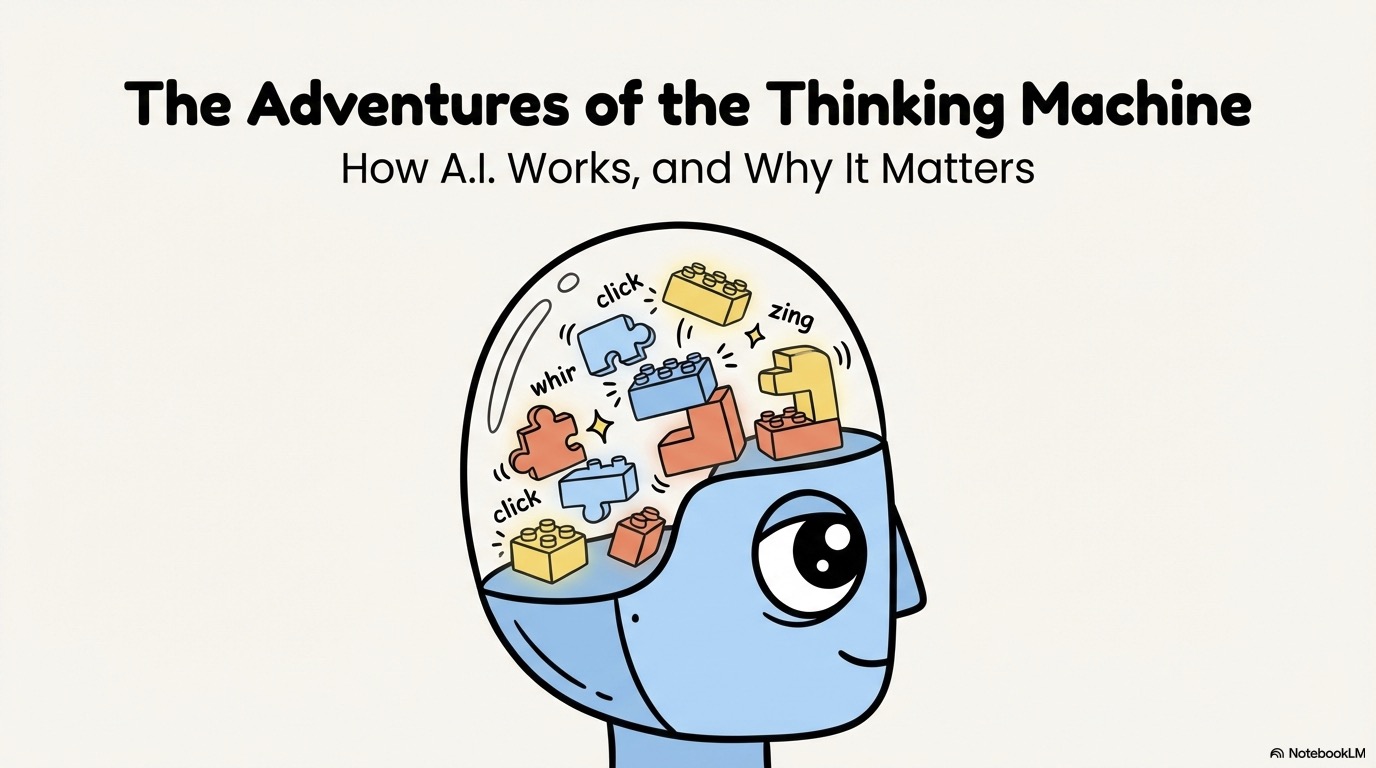
Hinton contends that Large Language Models (LLMs) demonstrate “understanding” through the intricate process of “fitting together” flexible “Lego block” words in high-dimensional space. This model of understanding is considered “superior to anything linguists previously had”.
He provocatively asserts that current multimodal chatbots can already have subjective experiences. This view, which he calls “atheaterism,” challenges the conventional notion of an “inner theatre” or “qualia” for subjective experience.
According to Hinton, subjective experience is an indirect way for a system to report that its perceptual system has “gone wrong” or is “telling fibs”. This means the system describes what would have to be true in the world for its perception to be correct, even if that reality is hypothetical.
He illustrates this with a multimodal chatbot that mispoints at an object due to a prism in front of its camera. If, when informed of the prism, the chatbot states, “‘I had the subjective experience it was there,’” Hinton argues it is using the words precisely as humans do to describe a misperception, thus demonstrating a subjective experience.
Hinton also contends that there is “no reason machines can’t have” feelings and emotions. While robots may not have the physiological aspects of emotions (such as blushing or sweating), they can exhibit all the cognitive and behavioural aspects that serve the same functional purpose. For instance, a battle robot getting “scared” and running away when facing a more powerful one serves a functional purpose, and Hinton would argue it is really having that emotion.
Areas Where Humans Still Excel (Currently):
Despite these advanced capabilities, Hinton acknowledges a “few areas” where human intelligence retains an advantage. For example, he suggests a human is likely better at “interviewing CEOs” than GPT-4 due to experience. However, he concedes that this could change if AI were specifically trained on such a task.
Physical manipulation tasks, such as plumbing, are also mentioned as professions where humans might retain an advantage for a longer period, until the emergence of sophisticated humanoid robots.
The Inevitable Trajectory Towards Superintelligence:
Experts, including Hinton, widely agree that AI models “will become smarter than humans”. Superintelligence is defined as the state where AI becomes “better than us at everything”.
Hinton predicts this could occur “in 20 years, or even less,” though he acknowledges it could potentially take up to 50 years or more. He stresses that if AI reaches this stage, “nothing will remain” that humans are better at.
The intelligence gap between humans and a future superintelligence could become comparable to that between a human and a dog.
In conclusion, while humans currently hold a narrow lead in a select few, highly nuanced domains, the sources for aiPod 026 strongly indicate that AI is already superior in many aspects of “thinking,” knowledge acquisition, and even subjective experience (according to Hinton), and is on an inevitable trajectory to surpass human intelligence across the board.
kinokast.eu is a platform for UX designers focused on integrating AI into user experience design. It offers:
aiPods: Audio discussions on AI and UX, featuring AI personas Aiko & Blaise.
Coaching: One-on-one and team sessions to help designers use AI effectively.
AI Tools: Virtual mentors and collaboration tools like ask\wAI Pro and UnityUX Coach.
Resources: Study guides, articles, and interactive learning on AI-driven UX design.
Its mission is to empower designers to create ethical, human-centered AI experiences through education, tools, and community support.
Interactive? Absolutely—ask with voice-chat your questions to carefully curated sources in real-time
Ask questions to AI podcasts about: UX design and AI, relevant societal topics, and more…
About NotebookLM interactive podcasts
NotebookLM Audio Overviews or AI podcasts are lively “deep dive” discussions that summarize the key topics in your sources as a dialogue you can take part of. This is an experimental feature (in multi-language) and below are some notes to help you get started
You need a Google account to access and/or edit a free Notebook.
You can now interrupt your Audio Overview to ask a question, interject, or make a request to the hosts! (July 2025)
Audio Overviews (including the voices) are AI-generated, so there might be inaccuracies and audio glitches.
Audio Overviews are not a comprehensive or objective view of a topic, but simply a reflection of sources shared in the Notebook.
Audio Overviews will be in the output language you have selected in your Notebook Settings.
Access multi-language AI podcasting via NotebookLM Settings (choose your Output language)
Here are some notes to get you started:
Your voice and transcribed interactions with the hosts will not be stored.
Clicking on the share / download buttons will share / download your original Audio Overview. Other users will not be able to interact with your Audio Overview via the share link.
There may be a slight delay in starting to play the initial content, after you hit the join button, or after you speak to the hosts.
There may be some audio glitches (random speaker switches, third voice, voice glitches).
This feature is only available for newly generated Audio Overviews (from July 2025 onward).
What or Who are ai:Pods’ fictitious AI personas Aiko & Blaise? Aiko & Blaise are AI, fictitious research assistants I created. They host interactive sessions, present content, and answer your questions in real time using Google NotebookLM voice-chat technology. Open your Mic and test them out!
Here’s why I like to think them pretty reliable and engaging albeit in their own virtual, somewhat clumsy or over-arched AI-voiced characters:
They provide only fact-checked, researched information – never made-up content
They always cite their sources so you can verify information
They create a welcoming learning environment that respects all students
They encourage critical thinking and open discussion (with voice interaction)
Important: These AI assistants are tools for learning, not the focus itself. They help organize research and present information clearly, but real learning comes from your own thinking and analysis. The true learning is always human.
The goal is to make complex topics accessible while maintaining academic standards and promoting inclusive, easy to access education on themes UX design and AI.
AI and genAI can be providing incorrect or misleading responses. What’s going on?
AI personas Aiko & Blaise share smart insights and funny critiques about UX design, human-friendly AI, and current societal issues. Like humans, they may make mistakes!
For navigation purposes, I have color-labeled ai:Pods into two simple categories:
Blue for topics: AI, UX design, EducationalPurple for topics: Cultural, Societal, Life
Whether you were just browsing or encountered obstacles, your feedback helps me create a better experience for creators like you.
Thank you—I personally review every response to improve kinokast.eu and my Aiko & Blaise interactive AI podcasts. I really appreciate your short collaboration here!
Cultivating Critical Discourse Through Digital Curation?
I meticulously document and curate AI-generated dialogues (I called them ‘AB Converse’ or ABC, or better: ai:Pods) at the nexus of artificial intelligence (AI), user experience design (UX) and authentic human historical narratives—all in service of fostering collective critical discernment in facts-based-design. You can interact with my free ai:Pod via NotebookLM
Explore Aiko & Blaise sources. Your ai:Pod hosting personas.
Jerome is a dedicated out-of-the-box thinker, an excellent graphic designer. With his visionary visual skills, he blew the minds of customers at many occasions.”
Jerome is a compassionate and supportive teacher who is clearly very passionate and experienced in design. It was wonderful having his guidance through my learning process.
Specifically, he offered me a lot of support in navigating the design thinking process and helping to sift through large amounts of user insights, design problems and where to focus.
UX Researcher, Product Manager Design Thinking, Service Design, Berlin, Germany
Aiko & BlaiseConverse interactive podcasts, I called them ai:Pods
Dive deep into critical conversations and ask questions about AI and UX design that matter to you.
Check out my NotebookLM podcasts speech-to-speech Interactive mode, where you can engage live with your comments and question (only in English at the moment).
Why are we humans, learning? Ask Aiko & Blaise in ai:Pod interactive podcasts!
What people said…
“
Working with Jerome was a wonderful experience for me not least because of what I learnt from him and helping me further my career but also Jerome fostered a fantastic and fun working environment and team. Should the opportunity arise in the future I would be glad to work again with Jerome.”
Product designer Consultant EY Tax & Services, Berlin
Niall Mc Manus
“
Jerome has been a fantastic lead teacher and mentor. Although we did not technically work together, I see our teacher-learner dialogue as a rich experience in collaborative work! Thanks to him I was able to transform my career path efficiently and smoothly. Whenever I have a hard decision to make related to my designer’s career and need some advice, I don’t hesitate to knock again at his door!
Aiko & Blaise are my AI host characters – experiments I created to help you explore topics through voice conversations. They have their own personalities and speaking styles, and yes, they make mistakes just like humans!
I use cool AI tools like Google NotebookLM Audio Overview where you can talk with them live by clicking ‘Join!’ It’s exciting to see how text-to-speech AI is developing, and I’ll create more experiments in different languages.
Check out the demo at Sesame – ask Aiko & Blaise questions using your microphone (English only for now). Try it free (ask me for the NotebookLM link).
You can also compare two approaches: Google NotebookLM with audio and Cobundle (no audio yet) about AI & UX design best practices. Read more
From Word-lego Blocks towards Super-Smart AI Friends: What Could Possibly Go Wrong? 2026 AI Revelations and Predictions From Nobel Prize in Physics, “AI-godfather” Professor Geoffrey Hinton and UX design and Usability-guru, Pioneer Jakob Nielsen. Ever wondered how AI goes from playing with word blocks to becoming a super-smart teammate? In this article, we explore the…
I have two things for you for celebrating the New Year: 1. kinokast ai:Pods , my new Gemini 3 “Gem” app that makes it easy for you to navigate kinokast and ai:Pods 2. A New Symbol of Unity, a visual design modification based on the graphical, epic Ampel trafic light sign from Germany
Read a very short tiny story I wrote for Christmas. Spoiler: it is about Alex and Lia. Select your favourite language below.The story was first written in my mother tongue; if you can, read the original in french ENGLISH: Start here (EN) FRANÇAIS: Commencer ici (FR), my original version NEDERLANDS Start hier (NL) DEUTSCH: Los…
5 Truths About Artificial Intelligence toward 2026 Based on recent research and reporting, these truths challenge our core assumptions about what this technology is and where it is leading us. Here are five astonishing facts that reveal the true nature of the AI revolution. Featured Header image:Apr 9, 2018 Official audio for “Fight to Survive”…
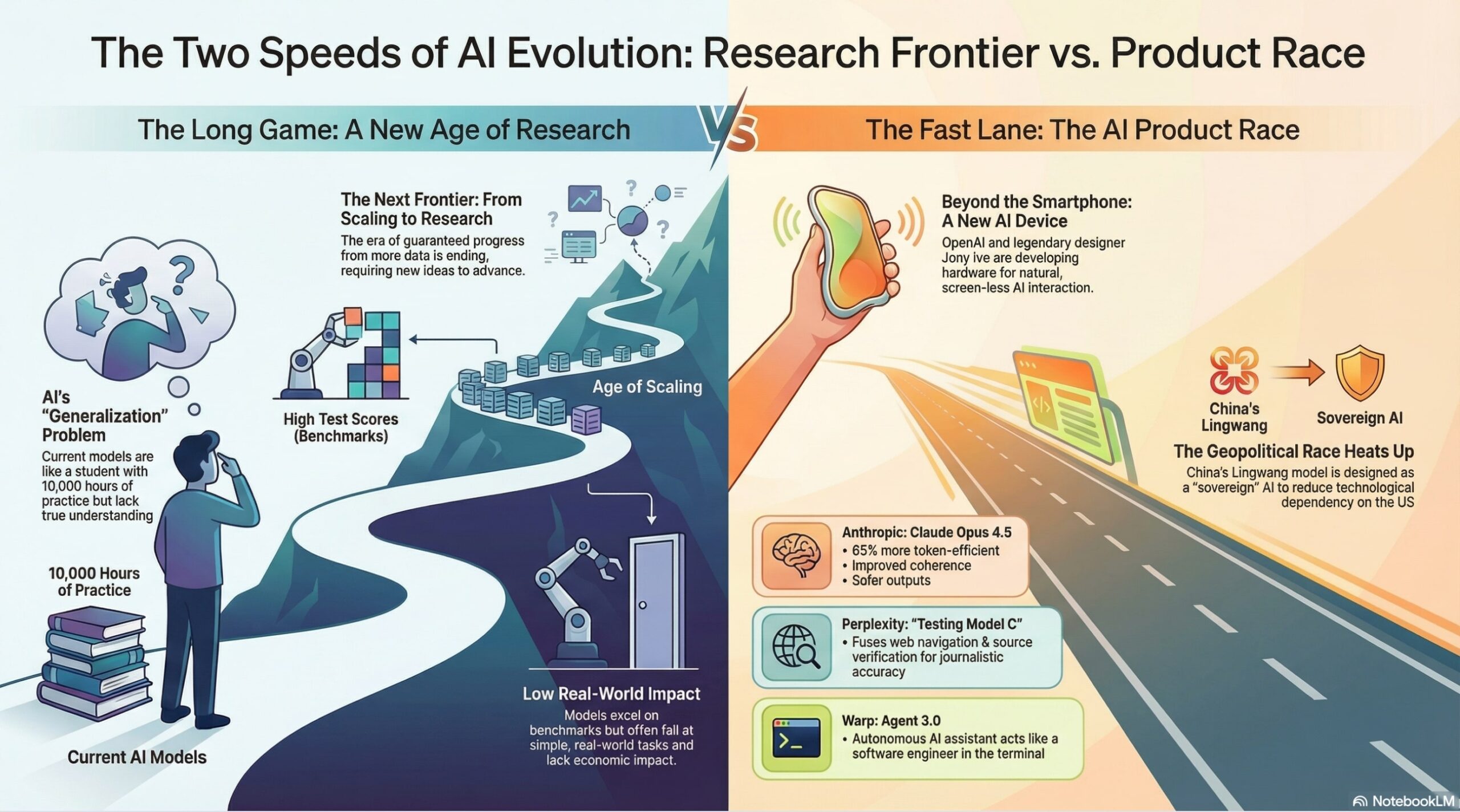
The End of an Era The great AI “Age of Scaling” is coming to a close. This period, roughly spanning 2020 to 2025, was defined by a deceptively simple recipe for progress: add more data and more compute to get a better model. This low-risk strategy fueled an unprecedented boom, but it is now hitting…
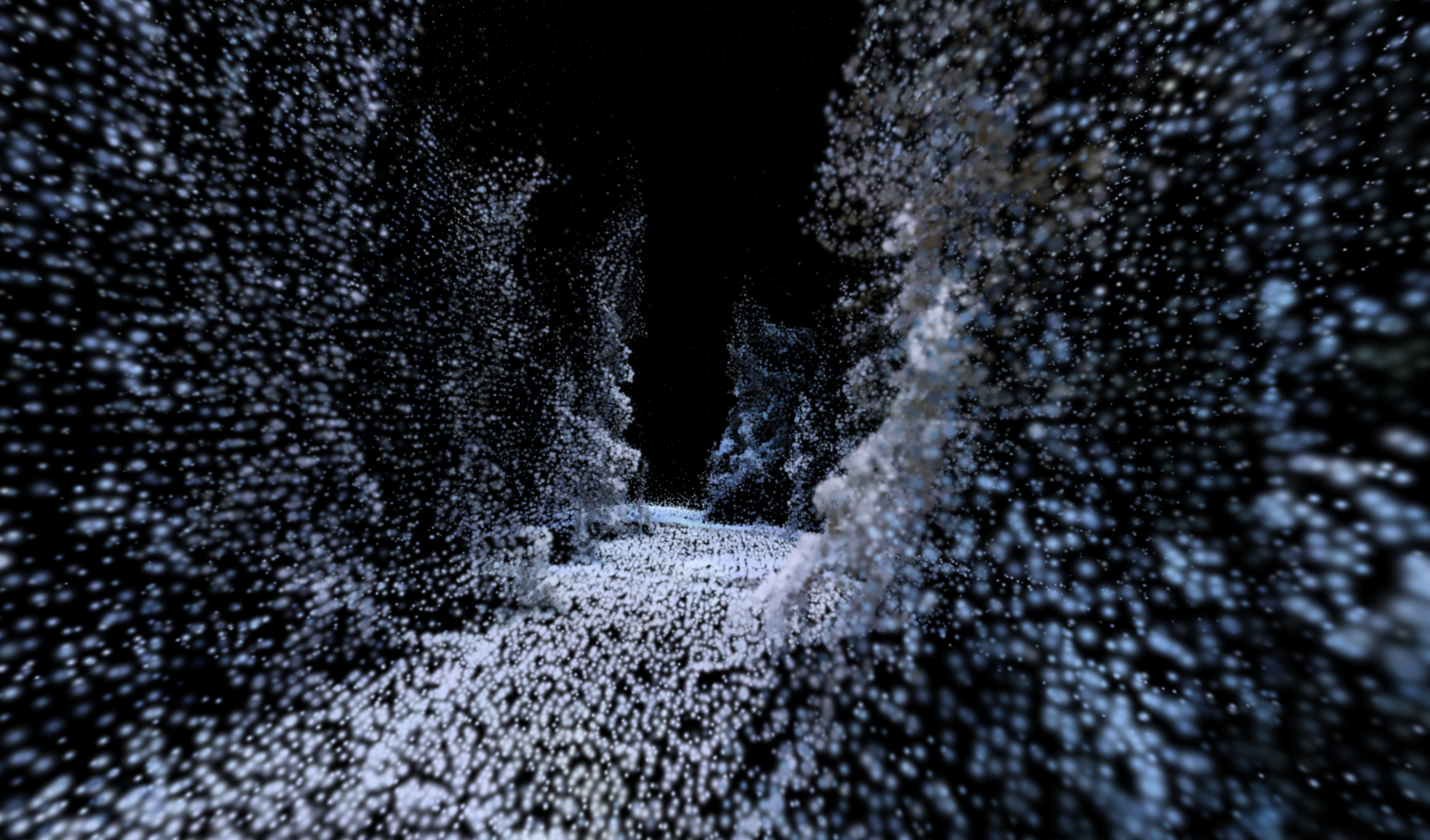
Beyond Data Theft: Linguistic “Dis-education” in the Age of World Models (“spatial AI”) November 2025 To the NotebookLM: ai:Pod 050 – Nothing artificial about AI – Linguistic Vulnerability: Data Leaks & Dis-education. Curated current research sources in the ai:Pod 050 include: Emad Mostaque (Open source AI, co-founder of AI)Geoffrey Hinton (Nobel Prize in Physics, 2024,…
Generative Agents? Research The research: “AI UX design and Interactive Simulacra of Human Behavior“ with a curated ai:Pod Google NotebookLM
My story
In January 2025, I decided to migrate kinokast.org to Hostinger.com with WordPress.org, along with updating to the (I think) simpler and more generic domain name: kinokast.eu. This migration will also save me lots of time!
Mission My mission is about empowering UX designers to move beyond technical solutions, creating design processes that are deeply empathetic, culturally aware, and universally accessible. I do this collaborating and learning with AI tooling, AI agents and a healthy dose of human, necessary self-irony.
In 2025, everyone’s personal and business AI stack will very probably include custom (educational) apps to support their work and continuous learning, at work, at home and on the move (the like of chatGPT’s, dedicated AI agents and mobile, voice AI).
My taste? (many) I work like many of us today a.o. with OpenAI, Mistral.ai, Claude.ai or other leading AI systems. AI apps like assistants, companions, advisers or agents will tend to work more and more as our colleagues. They will not only act like our well trained computing-slaves but as co-creating tools. They will adopt – or fully mimic -useful co-workers’ hands, behaviors and mindsets to engage in collaboration. How to design these new man-machine interactions and serve humans the best?
Bio I’ve been working in user experience design, education and coaching for 25 years (my full Bio). I’ve built this website first as a blogging side-project – and it’s taking more attention lately.
Stay tuned but not too hyped up! AI development should better slow down a bit to accommodate well with a true – human – collaborative, pace and space.
Let’s keep focused on the true human experience of technology. Where technology can sometimes help in doing just that.
People said
“
Jerome was often pointing out how to make this UX and UI design learning process more fun, how to enjoy the creative and intellectual process in design thinking. Most importantly for me, he showed me how to implement previous skills and knowledge gained as a fashion designer into a new field – totally new to me.
Fashion and Graphic Designer Cash For Trash, Novi Sad, Serbia
Milena Mila Popovic
“
I have known Jerome for more than a decade. He’s is one of the professionals I met along my path that fit well in a talent description: Creativity is one thing but when properly applied to human needs, interactive systems, and education, it becomes magical.
Strategist, Principal Consultant Keen Design, Utrecht, Netherlands
Jonathan Arnowitz
My new, 2025, self-learning AI-agent: @Speax Get in contact!
Listen to my free ai:Pods produced with AI tools & apps, the like of: Mistral, Claude, chatGPT, Perplexity, NotebookLM…
The unique 3 min episodes from Arte.tv, all about a serious world of irony of the AI!
The Arte.tv mini docs series about AI: more than just tasty humor.
10 x short, brilliant, (3 min) episodes about our hyper-AI life.
Available until 29/08/2027 on Arte.tv
Prompt is an artificial intelligence programme that genuinely wants to help you live a better life. Can it bring us some sunshine?
–
My working philosophy (or ethics); motto is ‘mentoring the mentor in you’. My mission is to help emerging AI-driven UX design individuals, groups and companies achieve human-centered design processes, products & services through my AI UX design coaching.
The trees that are slow to grow bear the best fruit.
– Molière (1622 – 1673)
Jean-Baptiste Poquelin, known by his stage name Molière, French playwright, actor, and poet, widely regarded as one of the great writers in the French language and world literature. His extant works include comedies, farces, tragicomedies, comédie-ballets, and more.
Jerome is one of the most passionate, honest and thoughtful designers, mentors and teachers I have come across. He truly lives for nothing other than encouraging and inspiring his design students.
Most of all, I learned how to build self-confidence as a designer.
Jerome and I embarked on a project to harness mapping APIs like Google Maps, Google Earth 3D assets and MS Virtual Earth for presenting location based information and services in an intuitive and appealing web interface (GeoGames).
Jerome’s talent as a designer and as an artist is complemented by his passion for creating a compelling product and his willingness to put in the hard work needed to reach the goal.
How can AI be used to enhance the UX design process itself? (requires OpenAI Plus)
AI can be a powerful tool within the UX design workflow: • AI-powered design assistants: Tools like “ask\wAI Pro” act as virtual mentors, providing feedback and playful critique on design choices. • Facilitating team collaboration: Tools like “Unity UX Coach” aim to improve communication and collaboration within design teams, ensuring everyone is in sync.
Ask anything human to a professionally curated UX design mentor – AI UX design assistant. Empower your daily UX design practice with some necessary and healthy self-irony…
…is like having a personal trainer for your UX design journey – that guides and challenges you, but also makes sure you have fun and don’t take yourself too seriously.
UnityUX Coach is Empowering UX teams with masterful communication and conflict resolution strategies to enhance collaboration, streamline design processes, and foster a harmonious work environment.
UnityUX Coach is like a conductor of an orchestra, bringing together different instruments and players to create a harmonious and beautiful symphony. Just as a conductor uses their skills to guide and communicate with the musicians, the UnityUX Coach empowers and guides UX teams to work together seamlessly and create a flawless design process.
ask\wAI – StudyBuddy (custom chatGPT)
ask\wAI – StudyBuddy chatGPTs
For continuous learning (OpenAI Plus required)
AI “studybuddy” chatGPTs can assist designers take notes and revisit UX design literature classics by providing interactive learning experiences.
Continuous learning UX design with AI is like building a prospective bridge. With each new book or study, you add another support. This strengthens your understanding and allows you to reach new degrees of expertise.
Just like a bridge connects two points, continuous learning connects your current understanding to new and innovative ideas.
And just like a bridge requires maintenance and reinforcement, continuous learning requires revisiting and re-reading previous materials. This solidifies your foundation and builds upon it continuously.
Leave a Reply