French academic scientists, the economist Frederic Lordon and philosopher Barbara Stiegler on failing neoliberalism embodied by French President Emmanuel Macron (2025)
French text below | Lire en langue française
A quite serious note about this GenAI header image taken from Jakob Nielsen’ blog, I oppose but purposely present here
A serious note about Nielsen’s blog’s header AI female avatar image
The header illustration I selected for this blog is a screen capture taken from Usability pioneer Jakob Nielsen’s recent LinkedIn post about AI Character’s voice (in-)consistency (his post’s context is user experience design and usability with AI voice).
The reason I have chosen that particular image is to expose my doubts about its designer’s choice. I’m unsure why this specific Aphrodite character was created and published by none other than veteran designer and researcher Jakob Nielsen, UX design and Usability “Guru” for 30 years, and especially why the whitewashed, sexualized AI speaking meme-like puppet should clarify Nielsen’s, otherwise valid point — particularly when visual design basics (as he’s amply aware of) recommend directing visual attention to the message itself, not only to the form.Is this character really meant to represent the field of Usability (read the subtitles of unambiguous or perhpas just ambiguous spoken text)? Does the visual avatar communicate anything more meaningful than the text alone?
All in all: I find the blog post AI avatar design and header image—essentially “just showing her apple(s)“— to say the least: quite questionable.Some may find this female avatar style amusing or a so-called clin d’oeil (a simple wink) to the Renaissance master paintings such as from Botticelli, but I’m repurposing this genAI avatar video image with a nore anthropological function here. I may be a way to illustrate France’s enduring political crisis: “Vous êtes la caricature de la bordélisation du pays !” (You are the caricature of the country’s total chaos). Note that “Le bordel” (= the brothel) used figuratively in French may also means total chaos).
Online Source:
French Media BFMTV 07/02/2023
“Vous êtes la caricature de la bordélisation du pays”: très vif échange à l’Assemblée entre Louis Boyard et Gérald Darmanin Interpellé par le député Louis Boyard ce mardi à l’Assemblée sur les violences policières, Gérald Darmanin lui reproche d’être “la caricature de la bordélisation du pays”.
English: “You are a caricature of the chaos in this country”: heated exchange in the National Assembly between Louis Boyard and Gérald Darmanin. Questioned by MP Louis Boyard on Tuesday in the National Assembly about police violence, Gérald Darmanin accused him of being “a caricature of the chaos in this country.”
This ai:Pod podcast and article in English and French are inspired, curated, and carefully human-sourced with research AI tools like Google NotebookLM. The content is interpretated courtesy of, amongst others serious sources, the recently held Oct. 2025 long interviews with French academics:
« UN FORCENÉ COMME MACRON NE LÂCHERA JAMAIS LE POUVOIR…PAR LUI-MÊME – Frederic Lordon » [ACCÈS LIBRE], elucid.media.
INTERVIEWS ELUCID. French video interview published Oct 12, 2025 on YouTube by Olivier Berruyer with French economist, philosopher and researcher of Political sciences, Frederic Lordon (CNRS, Centre National de la Recherche Scientifique).
« Il y a toujours une alternative en politique » avec Barbara Stiegler.
QG TV QUARTIER LIBRE. This French video interview published Oct 14, 2025 by QG TV on YouTube, Aude Lancelin with French political philosopher Barbara Stiegler, professor of Political philosophy at Bordeaux-Montaigne University France and honorary member of the Institut Universitaire de France.

To the fully sourced NotebookLM
(Multilingual Interactive learning with English only Voice Chat )
039
aiPod 039 – Organic Crisis Macron and Democracy – Lordon and Stiegler
(ENGLISH, 39:35min)
France’s Political Crisis: 4 Not-So-Shocking Truths in 2025
(Interactive Conversation With You on the NotebookLM)
Access and interact with the Full 039 ai:Pod NotebookLM sources with Interactive Voice chat (English Only).
The NotebookLM is public and free.
Language: English spoken
Courtesy of INTERVIEWS ELUCID interview published Oct 12, 2025 by Olivier Berruyer with Frederic Lordon.
Courtesy of QG TV QUARTIER LIBRE interview Oct 14, 2025 by Aude Lancelin with Barbara Stiegler.
AI may produce inaccurate information. GenAI (generative AI) may also be providing incorrect or misleading responses. What’s going on?
Beyond the Headlines
There is a widespread feeling that French politics is in a state of permanent chaos, a condition now commonly referred to by the evocative term bordélisation. Media narratives, quick to simplify, blame this instability on clashing personalities, party squabbles, or parliamentary theatrics. This view, however, is a profound misreading of the situation. The political disorder we see is not a temporary fever but an epiphenomenon—the surface manifestation of a deep organic crisis within contemporary capitalism.
What we witness in parliament is merely the symptom of a structural breakdown in the French economic and political order. This article explores four powerful, counter-intuitive ideas, drawn from recent political and economic analysis, that reveal the true nature of this crisis. They demonstrate that the chaos, the presidential deadlock, the recurring revolutionary spirit, and the exhaustion of old political divides are not separate problems, but interconnected consequences of a single, unravelling system.
——————————————————————————–
1. The “Chaos” (“Le Bordel”) Isn’t Coming from Where You Think
The term bordélisation was popularized by then- French Interior Minister Gérald Darmanin as a rhetorical weapon. By accusing the opposition of seeking to “bordéliser le pays,” he framed parliamentary disorder as the primary cause of the nation’s troubles.
“Vous êtes la caricature de la bordélisation du pays !” (You are the caricature of the country’s total chaos, the figurative “Bordel”, brothel)

This strategy, part of a cynical “cash talk” discourse, is set against the establishment’s constant, hollow appeals to a “sens de responsabilité” (sense of responsibility)—a moralizing posture that serious analysts dismiss as an “imbecility” and a “debility to be feared.”
The truth, however, is the precise inverse of the official narrative. The political chaos is not the cause but the consequence of a deeper societal disorder. It is the “capillary” rise of the chaos sown throughout society by decades of neoliberal and Macronist policies that have systematically “sacked” public services and social protections. The dysfunction visible in parliament is merely a reflection of a society pushed to its breaking point by this organized destruction.
From this perspective, the expression of societal anger in political institutions is considered “excellent news” by some analysts. It proves that a connection, however tenuous, still exists between the people and the bodies that are supposed to represent them.
The ultimate paradox lies in the group most accused of creating this chaos. La France Insoumise (LFI), while frequently targeted for its disruptive tactics, is described as the “least chaotic” political formation. This is because, as analysts note, “they have an analysis of the situation and know where they are going,” giving their political line a “granitic consistency and constancy” that stands in stark contrast to the volatile behavior of other parties.
2. Macron Will Never Resign. Here Are the Only Two Ways Out.
According to the psycho-structural analysis advanced by thinkers like Frédéric Lordon, the voluntary resignation of Emmanuel Macron is considered “impossible.” This is not a political calculation; it is rooted in his psychological makeup. The analysis uses the term “forcené”—an obsessive or relentless person—to describe him, concluding that the act of resignation is “orthogonal to his psychic structure.”
This insight is tied to a broader, more disturbing argument: the structures of “unleashed capitalism” actively select for leadership profiles with specific traits of perversion. These include a “denial of the alterity of others” and, most chillingly, an “enjoyment of throwing others into states of distress.” Such a profile is perfectly suited to managing the system’s brutal contradictions without being hindered by popular consent. This latter trait is exemplified by Macron’s habit of deliberately prolonging ministerial reshuffles, a delay seen not as indecision but as a way to savor the anguish and uncertainty into which he plunges ministerial aspirants.
Given this psychological and systemic lock, the analysis identifies only two potential exit scenarios:
1. A mass popular movement.
An uprising of a quasi-insurrectionary character could make his remaining in power physically and politically untenable.
2. He is “unplugged by capital” (“débranché par le capital”).
Macron is seen as a “proxy for capital.” If the financial markets and the business elites who support him (such as Bernard Arnault) decide he has become too much of a liability, they have the power to orchestrate his removal. The key signal would be a sudden shift in the editorial lines of their powerful media outlets. Should that happen, Macron’s political life expectancy would become “extremely short.”
3. The French Revolution Isn’t Over
A powerful framework for understanding the present is to see the 1789 French Revolution not as a closed historical event, but as an unfinished and recurring process.
According to this historical perspective, the Revolution initiated a long-term “democratic experiment” that was immediately marked by a “permanent tension” between two competing ideals: the aspiration for direct democracy, embodied by the sans-culottes, and the reality of an elected representative government. This unresolved conflict—between the people’s direct sovereignty and the authority of their delegates—is the engine that has driven the episodic resurgence of the revolutionary process throughout French history, from the Paris Commune of 1871 to the Popular Front of 1936.
This historical legacy is not merely academic; it connects directly to contemporary social conflicts. The Gilets jaunes (Yellow Vests) movement is a prime example. Protesters almost immediately mobilized revolutionary imagery, donning the “Phrygian cap” and brandishing “cardboard guillotines to decapitate King Macron.” These were not just theatrical props but symbols drawn from a deep cultural well, signifying that the current unrest is but the latest chapter in a long, ongoing, and unresolved struggle for the establishment of a real democracy.
4. The Real Fight Isn’t Left vs. Right Anymore
The current crisis runs so deep that it has rendered the traditional left-right political axis obsolete. This is not a matter of opinion, but of material reality: the basis for the social-democratic compromise that structured that axis—bringing capital and labor to the negotiating table—has been destroyed by neoliberal globalization.
The central, underlying economic contradiction that has shattered this old order is captured in a stark phrase:
“La bourgeoisie ne veut plus payer.”
(The bourgeoisie does not want to pay anymore)
This “insoluble budgetary equation” is the core of the organic crisis. As taxpayers, the bourgeoisie demands lower taxes, collapsing state revenue. But as holders of public debt, they demand that the state’s solvency be guaranteed. This fundamental contradiction forces the state to make the rest of the population the “adjustment variable,” leading directly to the “massacre” of public services and social protections described earlier. With capital now able to impose its will unilaterally, the basis for negotiation no longer exists.
In the vacuum left by this collapsed paradigm, a new political alternative is emerging. Thinkers like the philosopher Barbara Stiegler argue that France is not a “democracy” but a “régime électif” (elective regime), designed specifically to conjure the risk of democracy that arose from the Revolution. Stiegler proposes a “third way” called “democracy”—not a defense of the current system, but a radical hypothesis that opposes the two dominant, decaying blocs:
• The failing neoliberalism embodied by Macron. Stiegler characterizes this not as a small-state project, but one that relies on an invasive, enormous state to regulate every aspect of life in order to impose market logic.
• The rising threat of the far-right, described as an “ultralibéralisme fascisant.” Crucially, this is not a clone of neoliberalism. It represents a different, libertarian-authoritarian project that aims to reduce the state to its minimal functions of police, army, and customs.
This new axis pits a project of radical democratic renewal against the twin threats of a failing neoliberal order and a rising, state-shrinking authoritarian one.
An Open Future
These four perspectives converge on a single, powerful conclusion: the French political crisis is not an agitation of surface, but the epiphenomenon of a deep structural crisis of capitalism. The parliamentary chaos is a symptom of societal breakdown, not its cause. The presidency is locked by a psyche selected by the very system it serves. A revolutionary democratic spirit, centuries old and still unresolved, continues to resurface. And the exhaustion of the old left-right paradigm is giving way to a new struggle over the very meaning of democracy.

Interactive Mind Map ENGLISH + Voice chat
(Google NotebookLM)
This analysis does not predict the future, but it clarifies the terms of the fight. It leaves us with a fundamental question that extends far beyond France: Faced with the exhaustion of old models, what could a true democratic experiment look like in the 21st century?
En langue française
Crise Politique en France: 4 Idées Pas-Tellement-Choc pour Comprendre (2025)
Note Serieuse sur l’avatar IA en en-tête de ce blog
L’illustration provient d’une publication LinkedIn de Jakob Nielsen, pionnier de l’utilisabilité, traitant de l’incohérence vocale des personnages IA. J’ai choisi cette image car elle pose question : pourquoi cette Aphrodite blanchie et sexualisée devrait-elle servir un propos, du reste valide sur l’expérience utilisateur en général—quand les bases du design visuel exigent que l’attention reste sur le message, non sur une marionnette parlante hypersexualisée ?
Ce personnage est-il censé représenter l’utilisabilité ? Communique-t-il quoi que ce soit de pertinent ? Je trouve ce design d’avatar IA—qui se contente essentiellement de « montrer sa pomme (ou pommes) »—pour le moins discutable.
Certains y verront peut-être un clin d’œil amusant aux maîtres de la Renaissance comme Botticelli, mais je détourne ici cette image d’avatar genAI comme document anthropologique pour illustrer la crise politique française de fin 2025, résumée par : « Vous êtes la caricature de la bordélisation du pays ! » (Vous incarnez le chaos total du pays. « Le bordel » = littéralement le lupanar, utilisé au figuré pour désigner le chaos absolu).

Se référer aux Sources
Vers NotebookLM entièrement sourcé
(apprentissage interactif multilingue avec chat vocal en anglais uniquement)
039
Crise Organique Macron et Democratie – Lordon et Stiegler (FRANÇAIS, 25:08min)
Français. La Crise Politique en France: Quatre Idées Pas-Tellement-Choc pour Comprendre (2025)
(FRANÇAIS, 25:08min)
(Conversation interactive avec le Chat Vocal en IA, posez vos question en français, les réponses en anglais pour le moment)
Accédez à l’intégralité des sources 039 ai:Pod NotebookLM et interagissez avec vos questions en française grâce au Chat Vocal interactif multilingue (les réponses sont en anglais uniquement pour le moment).
NotebookLM est public et gratuit.
Langue : français
Avec l’aimable autorisation d’INTERVIEWS ELUCID , interview publiée le 12 octobre 2025 par Olivier Berruyer avec Frédéric Lordon.
Avec l’aimable autorisation de QG TV QUARTIER LIBRE, interview du 14 octobre 2025 par Aude Lancelin avec Barbara Stiegler.
L’IA peut produire des informations inexactes. L’IA générative (GenAI) peut également fournir des réponses incorrectes ou trompeuses.
Que se passe-t-il ?
Au-delà des gros titres
Le sentiment général est celui d’un chaos politique permanent, d’une instabilité que certains ont baptisée la « bordélisation ». Les récits médiatiques, prompts à simplifier, pointent du doigt des personnalités ou des stratégies partisanes pour expliquer la situation. Pourtant, cette lecture superficielle masque une réalité bien plus profonde. La crise que traverse la France n’est pas une simple querelle d’ego ou une défaillance passagère de ses institutions ; elle est la manifestation d’une crise structurelle, organique, dont les racines plongent au cœur du modèle économique et politique contemporain.
Comprendre ce qui se joue réellement exige de dépasser les explications convenues. Il faut se pencher sur les forces matérielles, les contradictions économiques et les héritages historiques qui façonnent notre présent. C’est en assemblant les pièces d’une analyse politique et économique rigoureuse que le tableau d’ensemble se révèle, souvent de manière surprenante.
Cet article propose d’explorer quatre idées fortes, tirées de ces analyses, qui vont à contre-courant des discours dominants. Chacune d’elles offre une clé de lecture essentielle pour décrypter la nature véritable du désordre actuel et les véritables alternatives qui se dessinent. Loin de n’être qu’une péripétie politicienne, la crise française est un symptôme d’une époque qui s’achève et d’un avenir radicalement ouvert.
——————————————————————————–
1. Le « bordel » ne vient pas d’où vous croyez
Le terme de « bordélisation » a envahi le débat public, mais sa véritable signification est double. Il est à la fois un outil rhétorique utilisé par le pouvoir et le symptôme d’un désordre bien plus profond qu’il ne le désigne en apparence.
Sa popularisation est d’abord le fait du ministre de l’Intérieur de l’époque, Gérald Darmanin, qui l’a employé dans une stratégie de « parole ‘cash’ » pour délégitimer l’opposition, en particulier la coalition de gauche Nupes. En lançant à un député de La France Insoumise :
« Vous êtes la caricature de la bordélisation du pays ! »
il cherchait à rejeter la responsabilité du chaos sur ses adversaires politiques.

Pourtant, une analyse structurelle inverse cette perspective. Le désordre politique visible au Parlement n’est pas la cause, mais la conséquence. Il est la remontée « par capillarité » du chaos massif que les politiques néolibérales et macronistes ont « semé dans toute la société ». Après avoir littéralement « mis à sac » la société, les services publics et les protections sociales, ce désordre sociétal finit par s’exprimer au cœur des institutions. Or, et c’est là l’idée la plus déroutante, cette expression parlementaire du chaos social est une « excellente nouvelle ». Elle est la preuve qu’une connexion, même ténue, subsiste entre les institutions politiques et le corps social qu’elles sont censées représenter ; un signe de vie dans un système en voie de décomposition.
Le paradoxe le plus frappant est que la formation politique la plus souvent accusée de « bordéliser », La France Insoumise (LFI), est décrite dans l’analyse comme étant en réalité « la moins bordélique » de toutes. En raison de la « cohérence et d’une consistance et d’une constance absolument granitique » de sa ligne politique, elle apparaît comme un pôle de stabilité dans un paysage politique en pleine déliquescence.
——————————————————————————–
2. Macron ne démissionnera jamais. Voici les deux seules issues.
Selon les analyses psycho-structurelles, une démission volontaire d’Emmanuel Macron est un scénario à exclure. Cette impossibilité ne relève pas d’un simple calcul politique, mais de ressorts bien plus profonds liés à la fois à sa personnalité et à la fonction qu’il incarne dans le capitalisme contemporain.
D’abord, sa structure psychique s’y oppose. Décrit comme un « forcené », un profil obsessionnel, la démission est un acte « orthogonale à sa structure psychique », et donc « impossible ». Loin d’être le « maître des horloges », il serait en réalité l’« esclave de sa psychée ». Son style de gouvernance est marqué par des traits de perversion, notamment le « déni de l’altérité d’autrui » et la « jouissance à jeter autrui dans des états de détresse ». Ce second trait s’illustre par son habitude de faire durer les remaniements ministériels, jouissant de l’angoisse et de l’incertitude dans lesquelles il plonge les aspirants.
L’idée la plus choc, cependant, est que ce profil psychologique n’est pas un accident. Il est activement sélectionné par les structures du capitalisme déchaîné. Dans un système « en voie de fascisation », la structure perverse, par son incapacité à reconnaître l’autre, possède le plus grand « dynamisme évolutionnaire ». Le système promeut et récompense ce profil psychique car il est le plus apte à exercer le pouvoir sans se laisser entraver par l’opposition ou le consentement.
Face à ce verrou, deux scénarios exclusifs sont identifiés pour son départ :
- Un mouvement populaire de masse : Un soulèvement quasi-insurrectionnel dans la rue qui rendrait son maintien au pouvoir matériellement intenable.
- Être « débranché par le capital » : Emmanuel Macron est analysé comme un « fondé de pouvoir du capital ». Si les marchés financiers et les grands dirigeants d’entreprises qui le soutiennent jugent qu’il est devenu un facteur d’instabilité trop coûteux, ils peuvent orchestrer son retrait. Le signal décisif viendrait d’un changement de ligne éditoriale dans la presse détenue par les grands capitalistes, comme Bernard Arnault. Un « pouce en bas » de leur part donnerait à Macron une espérance de vie politique extrêmement courte.
——————————————————————————–
3. La Révolution française n’est pas terminée
Une des idées les plus contre-intuitives pour comprendre la France d’aujourd’hui est de ne pas considérer la Révolution de 1789 comme un événement historique clos, mais comme un processus inachevé et récurrent.
Selon cette perspective, la Révolution a marqué le début d’une « expérimentation démocratique » où le peuple (le Demos) est devenu pour la première fois l’acteur de sa propre histoire. Cette expérimentation fut d’emblée marquée par une « tension permanente » entre l’aspiration à la démocratie directe, portée par les sans-culottes, et le principe des représentants élus. Loin de s’être achevé, ce processus révolutionnaire et la tension qu’il a inaugurée ne cessent de resurgir de manière épisodique tout au long de l’histoire de France, que ce soit en 1848, avec la Commune de Paris en 1871, ou lors du Front Populaire en 1936.
Ce puissant héritage imprègne encore les conflits sociaux contemporains. On a pu l’observer de manière spectaculaire lors du mouvement des Gilets jaunes, qui a très vite mobilisé l’imagerie révolutionnaire : le « bonnet phrygien » a refait son apparition sur les ronds-points, et certains manifestants ont brandi « des guillotines en carton pour décapiter le roi Macron ». Ces symboles ne sont pas un simple folklore ; ils témoignent de la persistance de cette culture politique. Cette perspective change radicalement notre regard : les contestations actuelles ne sont pas de simples perturbations, mais potentiellement la dernière expression en date d’une longue lutte, toujours irrésolue, pour l’avènement d’une démocratie réelle.
——————————————————————————–
4. Le vrai débat n’est plus gauche contre droite, mais une « troisième voie »
La crise actuelle est si profonde qu’elle rend obsolète l’ancien clivage gauche-droite. Pour saisir le véritable enjeu, il faut comprendre l’impasse matérielle qui le sous-tend avant d’envisager l’alternative radicale qui se dessine.
D’abord, le système politique français n’est pas, dans son essence, une démocratie. C’est un « régime électif » ou un « gouvernement représentatif » qui fut historiquement conçu par les penseurs libéraux pour une raison précise : « conjurer le risque démocratique » et l’exigence de démocratie directe que la Révolution française avait fait naître.
Ensuite, les conditions matérielles du compromis social-démocrate, qui structurait l’axe gauche-droite, ont été anéanties par la mondialisation néolibérale. La situation peut se résumer par une formule choc :
« La bourgeoisie ne veut plus payer. »
Cette formule recouvre une contradiction insoluble : en tant que contribuable, la bourgeoisie veut payer moins d’impôts ; mais en tant que rentière et détentrice de la dette publique, elle exige que la solvabilité de l’État soit garantie. Cette « équation budgétaire insoluble » détruit la base de toute négociation. Puisque le capital, fort de sa mobilité, n’a plus besoin de s’asseoir à la table des négociations, l’axe gauche-droite qui reposait sur ce dialogue a perdu son sens.
Face à cette impasse, des penseurs comme la philosophe Barbara Stiegler proposent une alternative : une « troisième voie » qui porte le nom de « démocratie ». Il ne s’agit pas de défendre le système représentatif actuel, mais de poser une hypothèse radicale qui s’oppose aux deux blocs qui s’affrontent aujourd’hui. Dans son analyse, Stiegler distingue d’un côté le néolibéralisme en échec (incarné par Macron), et de l’autre, la menace montante de l’extrême droite, qu’elle décrit comme un « ultralibéralisme fascisant » visant, à l’inverse du néolibéralisme, la destruction de l’État. La voie démocratique ne propose pas un retour en arrière, mais une véritable refondation.
——————————————————————————–
Un Futur Ouvert
Les quatre perspectives développées ici convergent vers une même conclusion : la crise politique française n’est pas une agitation de surface, mais le symptôme d’une crise structurelle profonde du capitalisme et des institutions politiques chargées de le réguler. Le chaos ambiant, l’obstination du pouvoir, la résurgence des symboles révolutionnaires et l’épuisement du clivage gauche-droite ne sont que les différentes facettes d’une même réalité. Comprendre ces forces souterraines est la condition indispensable pour ne pas se laisser abuser par le théâtre politique quotidien.
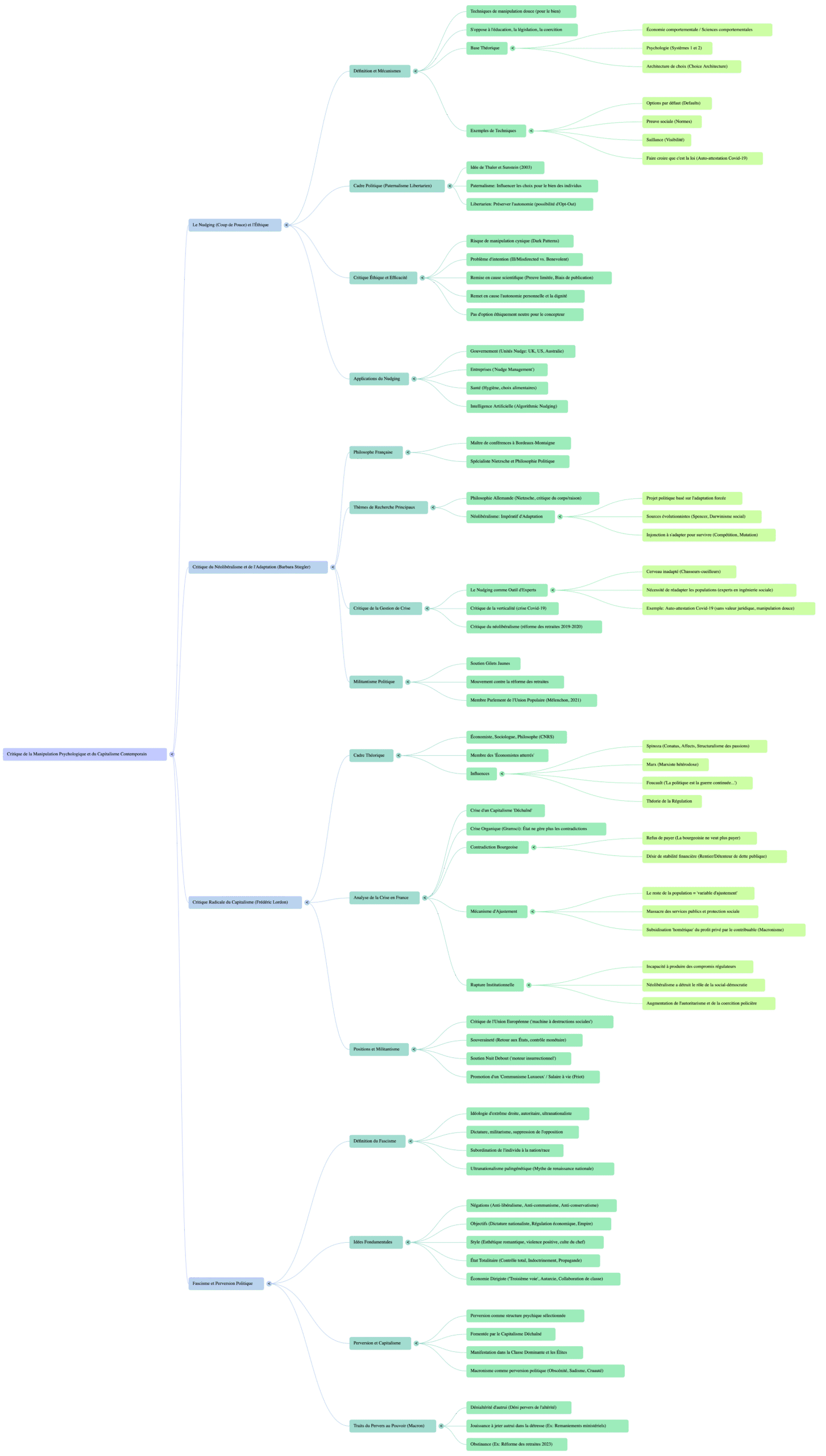

Interactive Mind Map in FRENCH
(Google NotebookLM)
Cette analyse ne prédit pas l’avenir, mais elle clarifie les termes du débat et la nature des enjeux. Elle nous laisse face à une question fondamentale qui dépasse les frontières de la France : face à l’épuisement des anciens modèles, à quoi pourrait ressembler une véritable expérimentation démocratique au XXIe siècle ?